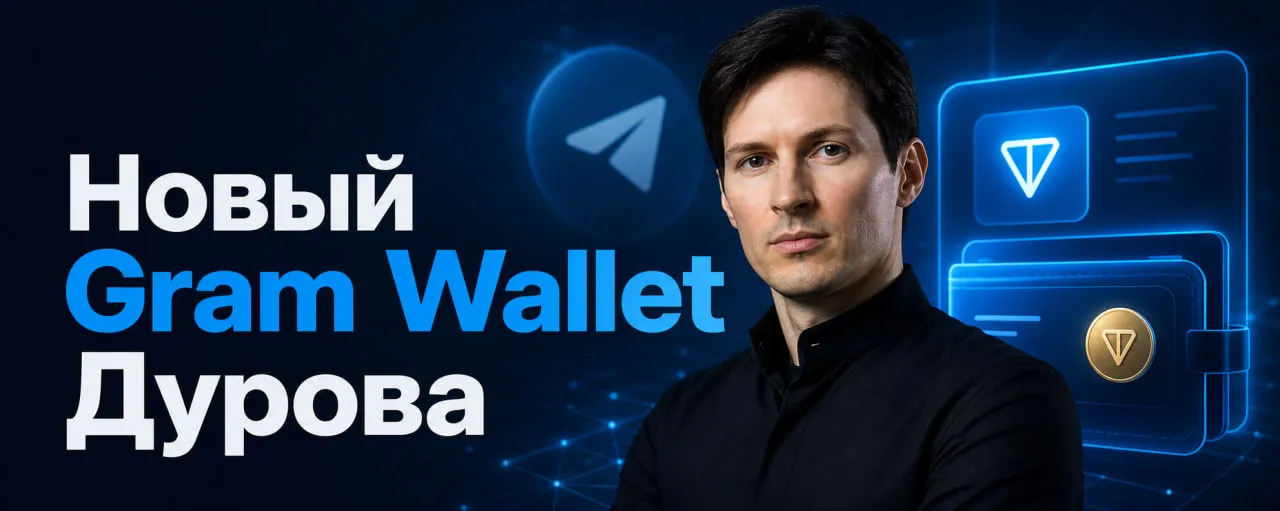
Pavel Durov is preparing a major update to Telegram's cryptocurrency infrastructure. In the summer of 2026, the messenger should receive a native non-custodial Gram Wallet — a wallet built directly into the Telegram application.
If the current Wallet works mainly as a separate service and Mini App, the new product should become part of Telegram itself. The user will be able to send cryptocurrency as simply as a regular message.
What Pavel Durov Announced
On July 21, Durov announced that Telegram is preparing the "largest non-custodial crypto wallet implementation in history." According to him, Gram Wallet will be available to users of all Telegram applications, whose audience exceeds one billion people.
Main promises:
- instant transfers;
- no commission for a number of operations;
- support for Gram cryptocurrency;
- built-in operation inside Telegram;
- user's independent ownership of keys.
Pavel Durov's Publication does not contain an exact launch date. Therefore, the wording "by the end of summer" is still better perceived as a guideline rather than a guaranteed release date.
Why Gram Wallet Appeared Specifically
In June 2026, the native currency of the TON blockchain was renamed from Toncoin to Gram. The blockchain itself retained the name TON, and the change affected only the token and its ticker.
Durov explained the renaming as a return to the original name of the cryptocurrency from the early Telegram Open Network project. Gram should become a more recognizable brand within the Telegram ecosystem.
The combination looks logical: Telegram, TON blockchain, Gram token and built-in wallet receive a unified naming system. For an ordinary user, this should look not like a separate cryptocurrency network, but as a built-in messenger function.
How the New Wallet Differs from the Existing Wallet
In Telegram, you can already open Wallet, buy and exchange digital assets, send cryptocurrency and work with TON. However, the current system combines different storage modes.
The official Wallet documentation separates:
- custodial Crypto Wallet, where keys are managed by the service;
- non-custodial DeFi Account, where responsibility for keys lies with the user.
The new Gram Wallet, judging by Durov's statement and published technical materials, is initially created as a separate native wallet with user control of keys.
This is a fundamental difference. In the custodial model, the service can help with access recovery. In the non-custodial model, the user is responsible for security themselves, and loss of the key may mean the final loss of funds.
What Has Been Confirmed at the Blockchain Level
A repository Telegram Wallet TON Contract has been published on GitHub. It describes the smart contract WalletTg intended for Telegram Wallet.
From the source code and documentation it follows that:
- the wallet code is stored in the TON configuration;
- all wallets use common current logic;
- code changes go through validator voting;
- public key change is provided;
- up to 255 messages can be sent in one batch operation;
- sending internal messages is supported, which can be used for operations without the need to separately hold TON for gas payment.
The update model is especially important. The user will not need to manually install a new version of the smart contract: after approval by validators, the updated logic is applied to the entire wallet system.
What the TON Voting Showed
On the TON Config Voting page, the proposal to add Telegram Wallet code to the TON configuration is already marked as accepted.
Currently, the page indicates:
- no active proposals;
- Telegram Wallet contract added to the configuration;
- the proposal received the status
accepted; - TON configuration already contains the code
WalletTg.
This means that the blockchain part of the wallet has been prepared and approved by validators. But the voting itself is not yet equal to a mass launch of the interface in Telegram. For a full release, client updates, inclusion of the user interface, and distribution of the function across regions and platforms are needed.
How the Wallet May Work
The expected scenario will look as follows:
- The user opens Telegram and sees Gram Wallet in the settings or profile section.
- Telegram creates a wallet and links it to the account.
- The user gets the opportunity to store Gram and other TON assets.
- The transfer can be sent directly from the dialogue.
- TON Connect can be used to interact with websites and Mini Apps.
- If necessary, the user will be able to change the key or transfer assets to an external wallet.
The exact method of creating and restoring the wallet has not yet been disclosed. It is unknown whether a regular seed phrase, split-key model or another recovery mechanism will be used.
What the Promise of "Commission-Free Transfers" Means
Zero commission most likely does not mean the complete disappearance of all expenses in the blockchain.
Network transactions still require payment for computations and data storage. Therefore, several options are possible:
- Telegram pays small commissions itself;
- the commission is covered by the sender through an internal system;
- relayer services are used;
- only transfers between Telegram users become free;
- payment remains when withdrawing to an external address.
The official website of the existing Wallet already states that transfers between users within Wallet can be free, and withdrawal to an external address is subject to network and service commissions. Therefore, the final tariffs of the new Gram Wallet will need to be evaluated only after the release.
Why the Launch Is Important for TON
Currently, most people have to separately install a wallet, deal with seed phrases, connect applications and pay commissions themselves. Telegram can remove almost all of these actions.
For TON, this opens access to a huge audience:
- users will be able to receive and send Gram in chats;
- Mini Apps will get a simpler way to accept payments;
- digital gifts and collectible items will be able to circulate within one system;
- it will become easier for developers to create paid functions;
- international transfers may become faster and more convenient than banking operations.
The main effect — cryptocurrency ceases to be a separate product. It turns into an ordinary Telegram function.
Main Risks
The mass distribution of the wallet also creates serious problems.
First, the number of fraudulent schemes will increase. After the appearance of the official Gram Wallet, fake websites, APK files, bots and "presales" will almost certainly appear.
Second, non-custodial nature transfers responsibility to the user. Hacking a Telegram account, email, SIM card or backup device can create a threat to access to assets.
Third, the wallet may be unavailable in certain countries. The official Wallet already warns that functions depend on local legislation and internal service restrictions.
Fourth, the issue of smart contract updates remains. Since the common wallet code can change through validator voting, it is important for users to understand how notifications, audits and control of such updates will be arranged.
What Is Known as of August 29, 2026
Now we can confidently state the following:
- Durov officially announced a native non-custodial Gram Wallet;
- launch is announced for summer 2026;
- TON token renamed to Gram;
- Telegram Wallet source code published;
- WalletTg contract added to TON configuration after validator voting;
- mass public launch in all Telegram clients has not yet been officially confirmed.
The most likely scenario — gradual inclusion of the function through Telegram update. First, the wallet may appear in test builds and on individual platforms, and then spread to the main audience.
For now, it is safer to use only official Telegram sections and the verified Wallet. You should not enter a seed phrase on third-party sites, install unknown applications or connect the wallet to "early access" offers.
If the launch takes place on the stated scale, it will not just be a new crypto wallet, but an attempt to turn Telegram into a full-fledged payment and Web3 platform.